After product pages, the most neglected money asset on a D2C store is the collection page. In audit after audit, I see the same pattern: the brand has a blog nobody reads, product pages copied from Amazon — and a collection page for their best-selling category that is nothing but a grid of products and two lines of copy. No keyword target. No buying guidance. No reason for Google to rank it, and no reason for a shopper to stay.
That is a costly miss, because collection pages are where commercial searches land. A buyer typing “best ayurvedic hair oil in India” or “protein bars under 300 rupees” does not want one product — they want a shortlist. Marketplaces win those searches by default today, not because your products are worse, but because your collection page never actually competes.
This guide fixes that, in the order I do it for D2C brands: keyword mapping first, copy that helps buyers choose, filters under control, internal links doing the heavy lifting, and festive collections that keep their rankings year after year. If you have not yet fixed the product pages these collections point to, read our product page SEO guide for D2C brands in India alongside this one — the two work as a pair.
TL;DR — if you fix nothing else:
- Build collections around real search demand — one collection, one clear intent (category, attribute, price band, occasion or problem). Delete or merge collections that exist only for navigation.
- Give every important collection a proper title, a short intro at the top and a real buying-guide section — a bare product grid is not a page, it is a shelf.
- Keep faceted navigation under control: only a small number of valuable filter combinations should be indexable. Everything else gets noindexed or canonicalised before it becomes duplicate bloat.
- Make collections your internal-linking hub: home and guides link in, collections link down to products. And keep festive collection URLs permanent — update them every year, never delete them.
The Short Answer: What Collection Page SEO Actually Is
Collection page SEO is the work of turning a category or collection page into the best possible answer for a group-level search — queries like “best X in India”, “X under ₹Y” or “X for [problem]”. It combines demand-led collection structure, an intent-matched title and copy, curated products, controlled filters, and strong internal links. A well-optimised collection can rank for dozens of related queries at once and pass that authority down to every product inside it.
Why Collection Pages Matter More Than Most Blog Posts
Founders often ask me why I prioritise collection pages over writing more blogs. Three reasons:
- The intent is commercial. Someone searching a category is comparing options with a wallet nearby. Someone searching a blog topic usually is not. Collection traffic converts at a different level entirely.
- One page, many queries. A single strong collection can rank for the head term, the price variant, the problem variant and the festive variant of a category — a blog post rarely covers that much commercial ground.
- Collections distribute authority. They sit between your homepage and your products. Links and rankings a collection earns flow down to every product page inside it — which is why this guide pairs with our broader guide to SEO for D2C brands in India.
Why Most D2C Collection Pages Fail to Rank
1. The collection was built for navigation, not for search
Collections get created because the menu needed them: “New Arrivals”, “Bestsellers”, a founder’s favourite grouping. Some of those deserve to exist, but they are not search pages. A collection with no real query behind it will not rank, and five tiny collections of four products each split what one strong collection could have won.
2. A product grid with no copy — or thin, auto-generated copy
Google ranks pages, not shelves. When a collection has no title beyond the category name, no introduction and no guidance, there is nothing to match against the buyer’s query and nothing to cite in an AI answer. The opposite failure is just as common: the same two templated sentences pasted across forty collections with only the category name changed. That is thin content at scale, and it reads that way to everyone.
3. Faceted navigation quietly creating hundreds of duplicate pages
Every filter combination — colour × size × price × sort order — can generate a new URL. Left uncontrolled, a 200-product store can produce thousands of near-identical collection URLs, diluting crawl budget and splitting rankings across duplicates of the same page. This is the single most common technical problem I find on growing D2C stores, and it is covered from the audit side in our technical SEO audit checklist for D2C stores.
4. Festive collections deleted after every sale
The Diwali collection ranks a little better every year it exists — until someone deletes it in November and recreates it the next September, starting from zero. Festive demand returns on schedule; your URL should too.
5. No internal links in — and weak links out
Collections that are reachable only through the main menu, never linked from guides, the homepage or related collections, grow slowly. And collections that link out to products with image-only links and no descriptive anchor text waste the hub they could be.
Step 1: Choose Collections by Demand, Not by Menu
Start from how buyers search, then check each candidate collection against real demand — your Search Console data if you have it, keyword tools, and the searches your support team hears. A practical mapping for a D2C store:
| Collection type | Query pattern it targets | Illustrative example |
|---|---|---|
| Core category | “[category] in India”, “buy [category] online” | Ayurvedic Hair Oils |
| Attribute | “sulphate free [category]”, “sugar free [category]” | Sulphate-Free Shampoos |
| Problem / use case | “[category] for frizzy hair”, “[category] for diabetics” | Snacks for Diabetics |
| Price band | “[category] under 499”, “best [category] under 999” | Lipsticks Under ₹499 |
| Occasion / festive | “Diwali gift hampers”, “Rakhi gifts for sister” | Diwali Gift Hampers (permanent URL, updated yearly) |
Two rules from experience: first, if a collection cannot name the query it exists for, it is a navigation page — keep it out of your SEO priorities (and often noindexed). Second, fewer, stronger collections beat many weak ones; merging three overlapping collections into one usually ranks better than all three did separately.
Step 2: Title, H1 and the First Screen
Your collection title should carry the category in the words buyers use, plus the qualifier that makes it yours — an attribute, audience or price point. Illustrative rewrites, created for this guide to show the pattern:
| Before | After |
|---|---|
| Hair Care | Ayurvedic Hair Care for Dry, Frizzy Hair — Oils, Shampoos & Masks |
| Snacks | Healthy Snacks Under ₹300 — High-Protein, No Refined Sugar |
| Sale Products | (Navigation page — keep, but do not treat it as an SEO target) |
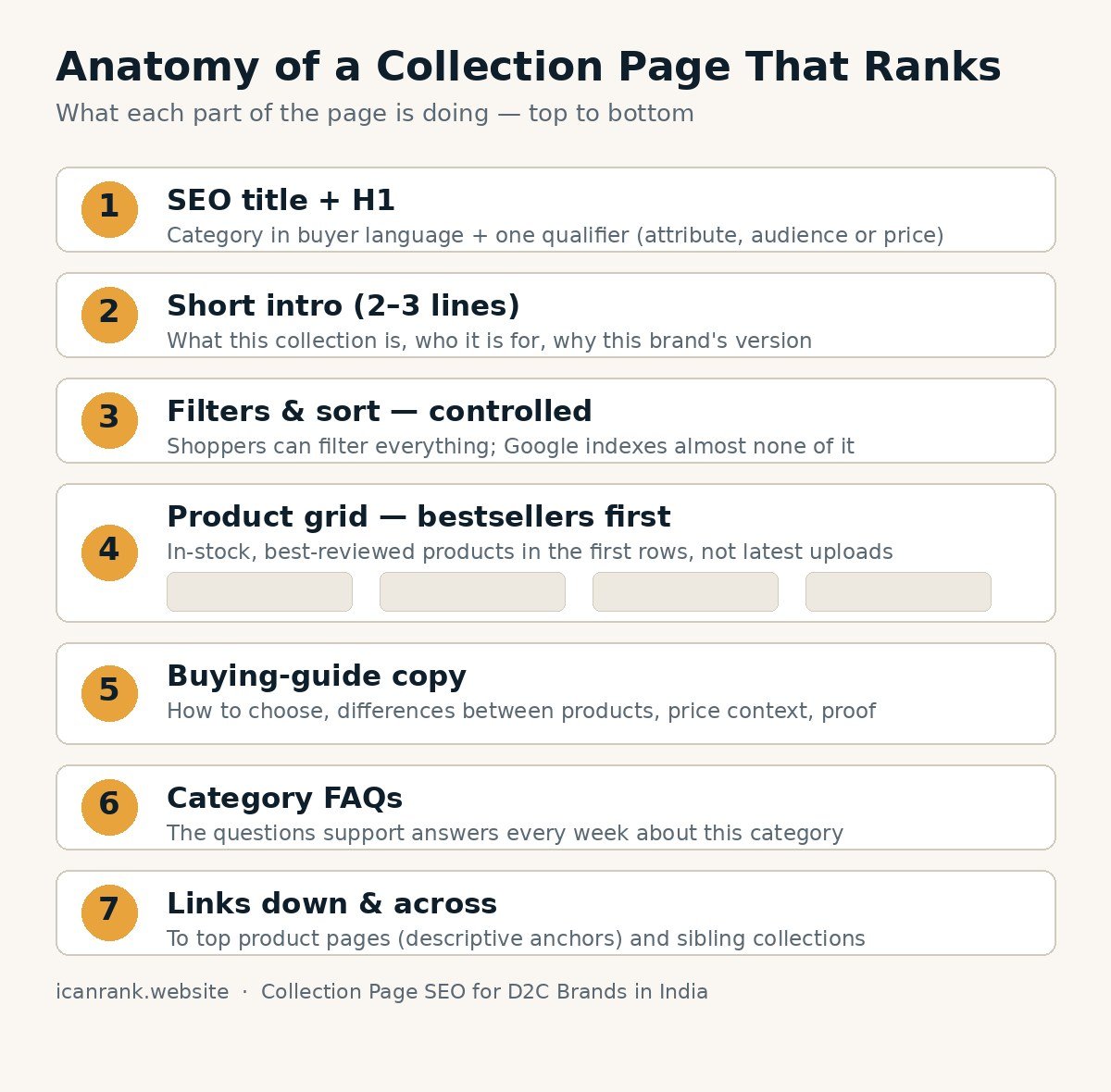
The first screen then has one job: confirm the shopper is in the right place and help them narrow down. Category name as a clear H1, two or three honest lines of introduction (what this collection is, who it is for, what makes it different), and the filters and sort controls a buyer actually needs. Long essays at the top push products below the fold and hurt more than they help — your detailed copy belongs in the buying-guide section further down (Step 3).
Step 3: Write Collection Copy That Helps Buyers Choose
Good collection copy is not an SEO essay; it is the advice a good salesperson gives. Place a short intro at the top and a fuller buying-guide block below the product grid, where it helps decided shoppers without blocking browsers. Cover:
- How to choose — the 3–4 factors that actually matter in this category (ingredients, strength, skin/hair type, pack size, price per unit).
- The differences inside the collection — which product suits which buyer, stated plainly. “If you have X, start with Y.”
- Bestsellers and proof — which products customers reorder, with links down to those product pages.
- Price and value context — ranges, combos, and what the budget option gives up versus the premium one.
- Category FAQs — the questions support answers repeatedly about this category (delivery, COD and returns belong on product pages too, but category-level doubts live here).
How long? As long as choosing well takes — for most D2C categories, a focused few hundred words across the intro and guide sections. Google has no preferred word count; forty collections with unique, decision-helping copy will always beat forty collections sharing one template.
Step 4: Curate the Products Inside the Collection
Rankings follow relevance and behaviour. Put your strongest products — bestsellers, best-reviewed, in-stock — in the first rows, not the newest uploads. Remove or fix what quietly damages the page: out-of-stock products sitting at the top for months, near-duplicate variants listed as separate products, and products that belong to a different intent entirely. When a priority product is temporarily out of stock, keep the collection honest — push it down or mark it clearly rather than letting buyers land on dead ends.
This is also where collections quietly compound your product work: every improvement you made using our product page SEO guide — unique titles, trust blocks, correct product data — makes the collection linking to those pages stronger too.
Step 5: Keep Faceted Navigation and Filters Under Control
Filters are for shoppers; indexation is for search engines. Confusing the two is how stores end up with thousands of junk URLs. The working rules:
- Let shoppers filter everything; let Google index almost nothing extra. Sort orders, grid views and most filter combinations should be noindexed or canonicalised back to the clean collection URL.
- Choose a small number of filter combinations worth indexing — the ones with real demand and enough products to deserve a page (for example, a “sulphate-free shampoo” view that your keyword mapping already identified as a collection in Step 1). Promote those to proper collections with their own titles and copy instead of leaving them as filter URLs.
- Keep URLs clean and stable. If a combination deserves a page, give it a readable URL of its own; do not rely on long parameter strings.
- Check crawl waste. If Search Console shows thousands of discovered duplicate collection URLs for a small catalogue, faceted navigation is the first place to look — this is a fixed item on my D2C technical audit checklist.
Step 6: Make Collections Your Internal-Linking Hub
A collection page is the middle of your site’s structure, and it should behave like it. Link into each priority collection from the homepage (featured categories), from relevant buying guides and blog posts, and from sibling collections where a shopper would naturally continue. Link out from the collection’s copy — not just its grid — to your best product pages with descriptive anchors, and link related collections to each other (a shopper on “Hair Oils” is one click from “Hair Masks”).
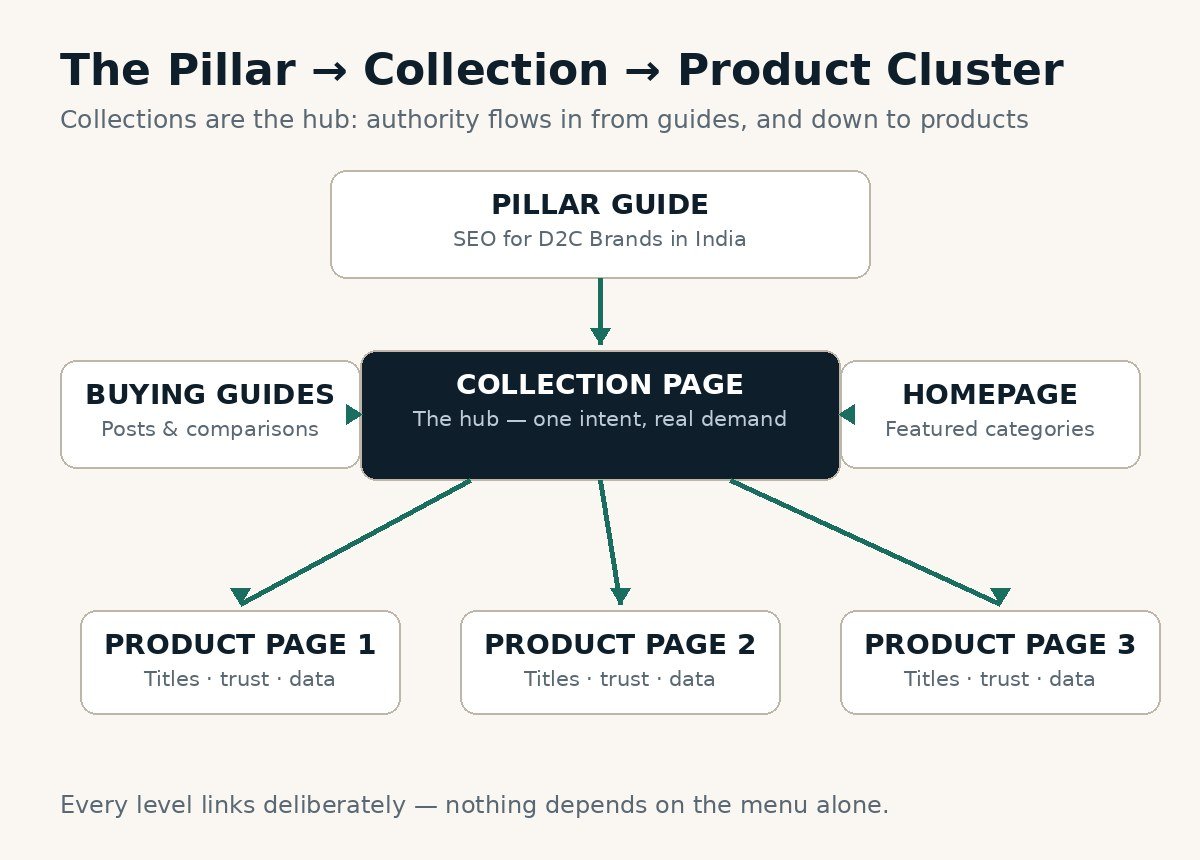
One practice that compounds: when you publish a new guide, add its link from the related collection, and add the collection’s link into the guide. A cluster where pillar, collections and products all point at each other deliberately will outgrow a site where links happen by menu alone. This pillar → collection → product structure is what the growth in our First Bud Organics case study was built on — as published on this site, ranking keywords grew from 40 to 78 in three months.
Step 7: Festive and Occasion Collections — Permanent URLs, Yearly Updates
India’s buying calendar is predictable: Diwali, Rakhi, Dussehra, wedding season, Mother’s Day, year-end sales. Create one permanent collection per occasion that genuinely fits your catalogue — the same URL every year — and refresh it in the weeks before demand peaks: updated products, current prices, this year’s gift guide copy, and links from your homepage banner while the season runs. Between seasons, leave the page live with a line pointing shoppers to your current bestsellers.
What not to do: create “/diwali-2026-sale/” in September and delete it in November. You are throwing away exactly the history that would have made next year’s page rank faster. One honest caveat — only build festive collections you can stock and fulfil properly; a ranking page that delivers a bad festive experience costs you repeat buyers, which are the whole point of D2C.
A Worked Example: One Collection, Before and After
An illustrative example, built for this guide — a composite, not a client page and not a results claim:
- Before: A D2C personal-care brand has a “Hair Care” collection: 38 products in upload order, the first row half out of stock, no introduction, no guide copy, 600+ indexable filter URLs, and a “Diwali Combo” collection deleted after last year’s sale.
- Fix 1 — structure: Split by demand into three collections with real intents — Ayurvedic Hair Oils, Sulphate-Free Shampoos, Hair Masks for Dry Hair — and merged two overlapping “offers” collections into the navigation only.
- Fix 2 — titles and copy: Each collection gets a buyer-language title, a 3-line intro, and a buying-guide section explaining which product suits which hair problem.
- Fix 3 — curation: Bestsellers moved to the first rows, dead stock removed, near-duplicate variants consolidated.
- Fix 4 — filters: All filter/sort parameters canonicalised to the clean collection URLs except the combinations promoted to collections in Fix 1.
- Fix 5 — festive: One permanent “/diwali-gift-hampers/” style collection, refreshed annually, linked from the guide content each season.
- Fix 6 — links: Homepage featured-category slots, two buying guides and sibling collections now link in; the guide sections link down to the top product pages.
What to watch afterwards in Search Console: impressions for the collection’s non-brand queries, the number of duplicate collection URLs shrinking, and revenue per organic collection session. Category rankings build over months, not days — the compounding is the point.
The Collection Page SEO Checklist (Copy-Paste)
- Every priority collection can name the exact query/intent it exists for.
- Collections built for navigation only are excluded from SEO targets (noindex where appropriate).
- Overlapping collections merged; tiny collections consolidated into stronger ones.
- Title/H1 carry the category in buyer language plus a qualifier (attribute, audience or price).
- Short intro at the top: what it is, who it is for, why this brand’s version.
- Buying-guide section below the grid: how to choose, differences, bestsellers, price context, category FAQs.
- Copy is unique per collection — no shared template text with the name swapped.
- Bestsellers and in-stock products occupy the first rows; dead stock and duplicates removed.
- All sort/filter parameter URLs noindexed or canonicalised to the clean collection URL.
- The few filter combinations with real demand are promoted to proper collections with their own copy.
- Festive collections use permanent URLs and get refreshed before each season — never deleted.
- Homepage and relevant guides link into each priority collection.
- Collection copy links down to top product pages with descriptive anchor text.
- Sibling collections cross-link where a shopper would naturally continue.
- Collection page loads fast on mobile; filters work without breaking the layout.
- Search Console checked monthly for duplicate collection URLs and non-brand query growth.
Mistakes That Waste a Season
- Copying the marketplace category structure blindly. Amazon’s taxonomy serves Amazon’s catalogue, not your 200 SKUs or your buyers’ searches.
- Writing one template and swapping category names. Forty thin pages is a scaled-content pattern, not a strategy.
- Deleting festive pages after the sale. You reset a year of ranking history for tidiness.
- Indexing every filter combination “for more pages”. More pages, less ranking — duplicates compete with your real collection.
- Burying products under a 1,500-word essay. Copy helps buyers choose; it should never make them scroll past the shopping to find the products.
- Judging collections by traffic alone. A collection’s job is revenue and product discovery. Measure both.
How to Measure Whether It Is Working
In Search Console, group your reporting by collection: impressions and clicks for non-brand category queries, click-through rate against your product pages, and the count of duplicate or parameter URLs Google is discovering — that number should fall after Step 5. In your store analytics, track revenue per organic collection session and how many product-page views each collection drives. Review monthly; do a real refresh of your top collections before each festive peak, updating products, prices and copy — and only then touch the modified date.
FAQs
What is the difference between product page SEO and collection page SEO?
Product page SEO wins searches for one specific item — a name, a variant, a use case. Collection page SEO wins group-level searches where the buyer wants a shortlist: “best X”, “X under ₹Y”, “X for [problem]”. The pages need each other: collections earn the broad commercial traffic, products convert it, and each links to the other.
How much copy does a collection page need?
Enough to help a buyer choose confidently: a few lines of introduction at the top and a focused buying-guide section below the grid — for most categories, a few hundred words in total. There is no magic number. If a paragraph does not help a shopper decide between the products on that page, it does not belong there.
Should filter and sort pages be indexed by Google?
Almost never. Sort orders and most filter combinations are duplicates of the collection with products rearranged, and indexing them splits your rankings. The exception is a combination with genuine, proven demand — and the right move there is to promote it to a real collection with its own title and copy, not to index a parameter URL.
How many collection pages should a D2C store have?
As many as there are distinct, demanded intents in your catalogue — no more. For most growing D2C brands that means a handful of core categories plus a small set of attribute, problem and price collections. If a collection exists only because the menu looked empty, merge it.
Should I delete festive collection pages after the season ends?
No. Keep the URL live, point shoppers to current bestsellers in the off-season, and refresh the page before the next season. Festive demand returns every year, and the page’s history is what lets it rank faster each time. Deleting and recreating it resets that compounding to zero.
Is collection page SEO different on Shopify?
The strategy is identical; only the controls differ. Shopify collections are straightforward to title and describe, but its filter and sort parameters need the same discipline — canonical/noindex control and promoting valuable combinations to real collections. The copy, curation and linking work in this guide applies platform for platform.
Can a collection page rank instead of a blog post for “best X” queries?
Yes — and for a store, it usually should. “Best X” searchers want to compare and buy, so a well-built collection with buying-guide copy matches the intent better than an article that sends them elsewhere to shop. Many brands run both: the guide for research-phase queries, the collection for buying-phase ones, linked to each other.
When to Do It Yourself — and When It Needs an Audit
If your catalogue is tidy and your collections are few, this checklist is a weekend job: map intents, rewrite the top collections, lock the filters down. It stops being a weekend job when your store has hundreds of products, years of accumulated filter and tag pages, or collections that get traffic but no revenue and nobody knows which layer is failing. That is an audit conversation, not a longer checklist.
That is the work I do. If you want collection and product structure fixed together, see my SEO services for D2C brands, or get in touch for an audit and send me your store URL and your top three categories. I will tell you honestly whether the checklist is enough — or what is actually leaking.
— MD Raqib Alam, SEO and organic growth specialist, Kolkata