In almost every D2C audit I do, the product page is where the money leaks — quietly. The founder shows me the ad dashboard first. Then we open their bestseller on Google, on a phone, the way a buyer in Indore or Kochi would see it. No price in the result. No rating. A description I have already read on Amazon, word for word. And the three questions that actually decide the purchase in India — Is COD available? When will it reach my PIN code? Can I return it? — are three scrolls below the buy button, if they are answered at all.
I have made the opposite mistake myself: rewriting product descriptions to be “SEO-friendly” until they sounded like a keyword list and stopped sounding like a person selling a real product. Buyers can tell. So can Google.
This guide is the order I now fix product pages in — keyword first, trust early, schema last — and what I check before I tell a founder their page is ready. It is written for Indian D2C and ecommerce brands selling from their own store. If you want the bigger picture first, start with our complete guide to SEO for D2C brands in India. This post goes deep on one thing only: the product page itself.
TL;DR — if you fix nothing else:
- Give every product page one clear search intent and a title written in the language buyers actually search in — not just the product name.
- Never publish the supplier or marketplace description as-is. Unique copy plus an early trust block (COD, delivery estimate, returns) is what turns Indian search traffic into orders.
- Make your price, availability and ratings eligible to show on Google with accurate Product structured data and a Merchant Center feed that matches the page exactly.
The Short Answer: What Product Page SEO Actually Is
Product page SEO is the work of making a single product page easy for Google to understand as a specific, purchasable product — and easy for a shopper to trust within ten seconds. It combines one matched search intent, unique and useful copy, visible trust signals, accurate product data, and clean internal links. Done properly, the page can rank, earn rich results like price and ratings, get cited in AI answers, and convert the click instead of wasting it.
One myth to clear up first: you do not need any special “AI schema”, an llms.txt file, or content chopped into tiny chunks to appear in Google’s AI features. Google’s own guidance for generative AI search says classic SEO fundamentals still apply, and that unique, first-hand, non-commodity content matters most. That is exactly what this guide builds.
Why Indian D2C Product Pages Specifically Fail to Rank
Most product pages do not fail because the founder picked the wrong keyword tool. They fail in five predictable ways, and I see the same five in audit after audit.
1. The same copy as Amazon, Flipkart and the manufacturer
If your description is copy-pasted from your supplier or your own marketplace listing, Google has no reason to rank your page over the marketplace. Amazon and Flipkart carry enormous authority, faster delivery promises and thousands of reviews. The one advantage your own store has — a sharper, more specific, more honest page — is thrown away the moment the copy is identical.
2. The title is just the product name
“Hair Oil 100ml” is a label, not a search match. Buyers search by problem, use case and attribute: “hair oil for frizzy hair”, “non sticky hair oil for daily use”, “ayurvedic hair oil for hair fall”. A title that contains only the product’s name matches almost none of the language that brings buyers to Google.
3. Google cannot see a purchasable product
Missing or wrong Product structured data, no Merchant Center feed, or a price on the page that does not match the feed — any one of these can cost you the price, rating and availability display in search results. You lose the click before the buyer ever reaches your page.
4. The trust answers are buried
Indian shoppers decide on COD availability, delivery time to their PIN code, return conditions and authenticity long before they admire your brand story. If those answers sit in a footer, a FAQ tab nobody opens, or nowhere at all, the shopper goes back to Google — or to the marketplace listing of your own product.
5. A thin, slow mobile page
Most D2C traffic is mobile. A heavy hero image, too many app scripts and layout that jumps while loading will quietly eat the rankings and conversions the other fixes earn. The site-wide technical side of this is covered in our technical SEO audit checklist for D2C stores — here, just know that the product page is where slow templates hurt revenue first.
Step 1: Map One Keyword and One Intent to One Product Page
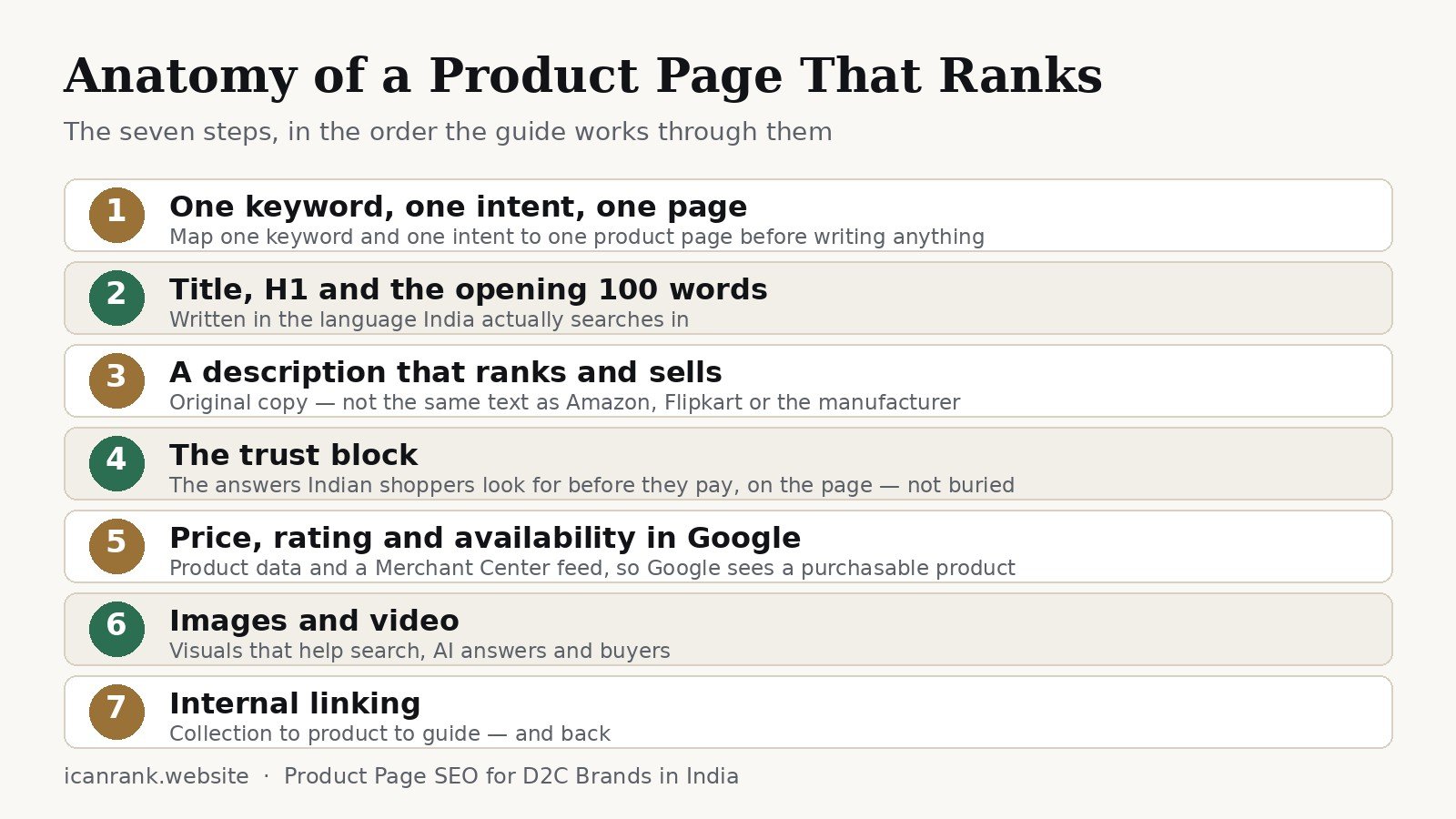
Every product page should own one primary intent. Not five keywords stuffed into a title — one job: this page is the best answer for this kind of buyer searching in this kind of way. When two of your pages chase the same intent — usually a product page and its collection page — they cannibalise each other and both rank worse.
A simple mapping I use with D2C brands:
| Query type | Example pattern | Page that should target it |
|---|---|---|
| Product / attribute | “cold pressed coconut oil 500ml”, “matte lipstick for dusky skin” | The product page |
| Problem / use case | “oil for dry frizzy hair”, “snack for diabetic parents” | The product page (title + opening copy), supported by a guide |
| Category / comparison | “best ayurvedic hair oils in India”, “protein bars under 300 rupees” | The collection / category page |
| Brand | Your brand + product name | The product page — you must win this one |
Start with your top 10 products by revenue, not your whole catalogue. Fixing the pages that already sell is how product page SEO shows results fast enough for a founder to care.
Step 2: Write the Title, H1 and Opening 100 Words in the Language India Searches In
Your page title and H1 do two jobs: they tell Google what the page is for, and they earn the click. A working formula for a D2C product page is: Product name + key attribute or benefit + use case or audience. Then the opening 100 words must confirm, in plain language, who this product is for, what problem it solves, and why this one.
Illustrative examples — these are rewrites I created for this guide to show the pattern, not client work:
| Before | After |
|---|---|
| Hair Oil — 100ml | Cold-Pressed Coconut Hair Oil for Dry, Frizzy Hair — Non-Sticky, Daily Use (100ml) |
| Protein Bar (Pack of 6) | High-Protein Snack Bars for Post-Workout Hunger — 15g Protein, No Refined Sugar (Pack of 6) |
| Face Wash | Gentle Face Wash for Oily, Acne-Prone Skin — Sulphate-Free, For Daily Use in Indian Weather |
Notice what changed: the searcher’s words moved into the title, and a reason to choose this product came with them. Notice also what did not happen — the keyword is not repeated five times. Keyword stuffing reads badly, converts badly, and is a spam signal. Write the title you would be proud to read out loud to a customer.
Step 3: Write a Product Description That Ranks and Sells
There is no magic description length, and Google has said plainly that it has no preferred word count. What matters is that the description answers the buyer’s real questions better than the marketplace listing does. The structure I recommend, in order:
- Who it is for — and, honestly, who it is not for. Specificity builds trust.
- The problem it solves, in the buyer’s words.
- What it is — ingredients, materials, specifications, sizes, how it is made.
- Proof — certifications, testing, real reviews, your case for authenticity.
- How to use it — quantity, frequency, what results to expect and in what timeframe, stated honestly.
- Comparison and objections — versus the obvious alternative, plus the questions support teams answer every day.
Triage your effort: hero SKUs that drive revenue deserve a full, original description. Long-tail SKUs still need unique copy, but a tighter version of the same structure is fine. What no SKU should ever carry is the supplier’s paragraph, copied. That single habit is the most common reason Indian D2C product pages stay invisible.
This is the approach behind the organic growth in our First Bud Organics case study — as published on this site, ranking keywords grew from 40 to 78 in three months and average position improved from 9.8 to 7.7. No tricks: intent-matched pages, unique content, and steady technical hygiene.
Step 4: Add the Trust Block Indian Shoppers Look for Before They Pay
On a marketplace, trust comes from the platform. On your own store, the page has to supply it. Place a compact trust block near the buy button — visible on mobile without scrolling through tabs:
- COD available (if you offer it) and payment options like UPI and cards.
- Delivery estimate — a realistic range, ideally PIN-code aware.
- Returns and replacement policy in one plain sentence, with a link to the full policy.
- Authenticity and quality signals — FSSAI, Ayush, dermat-tested, lab reports, whatever genuinely applies to your product.
- Real customer reviews with photos, including the imperfect ones. A page with only five-star praise reads as staged.
Do not promise what your operations cannot honour. A trust block that over-promises delivery or returns will earn you chargebacks and bad reviews, which cost far more than the clicks it won.
Step 5: Get Price, Rating and Availability Into Google — Product Data and Merchant Center
This is the step most D2C founders skip, and it is the one that changes how your product looks on Google before anyone clicks. Two systems work together: Product structured data on the page and a Merchant Center feed. The rule that governs both is simple: page, schema and feed must agree — same price, same availability, same product.
| Field | What Google needs | Common D2C mistake |
|---|---|---|
| Name, image, brand | The real product name, a clear product image, your brand | Marketplace titles copied with keyword strings |
| Price (offers) | Current price with currency INR, matching the page | Sale price on the page, old MRP in the feed |
| Availability | In stock / out of stock status that updates | Out-of-stock products still marked available |
| Ratings (aggregateRating) | Only from genuine reviews visible on the page | Self-written ratings — this risks a structured-data penalty |
| Shipping and returns | Shipping details and your merchant return policy | Left blank, so Google shows competitors’ terms instead |
| Identifiers | SKU, and GTIN/barcode where the manufacturer provides one | Fake or borrowed GTINs |
After adding or fixing the markup, validate the page in Google’s Rich Results Test, and keep the Merchant Center feed synced — most D2C platforms can push it automatically. One compliance note from Google’s current guidance: if you use AI to generate product titles, descriptions or images for Merchant Center, that content must be labelled as AI-generated in the feed, and AI product images carry specific metadata requirements. And always fact-check generated product data before it goes live — a wrong price in structured data is your problem, not the model’s.
Step 6: Images and Video That Help Search, AI Answers and Buyers
Product images are not decoration; they are evidence. Use descriptive file names (cold-pressed-coconut-hair-oil-100ml.jpg, not IMG_4821.jpg), write honest alt text that describes the image for someone who cannot see it, and show the product in real use — in a real hand, on real hair, next to a real meal. Buyers, Google Lens and AI answers all read images as proof of what the product is.
Add one short, real video per hero product where you can: a 30–60 second demonstration or founder explanation. Video is often the fastest trust-builder a D2C page has — it is a large part of how product discovery played out in our Grandmaa Secret case study, where YouTube became the brand’s growth engine. Keep the video light so it does not undo your page speed.
Step 7: Internal Linking — Collection to Product to Guide, and Back
A product page with no internal links pointing to it is an orphan, and orphans rank slowly no matter how good the copy is. The linking pattern is simple:
- Every product page links up to its parent collection, so authority flows both ways.
- Collection pages link down to their important products with descriptive anchor text — the product’s name and key attribute, not “click here”.
- Relevant guides link across to the product or collection where a reader would naturally want it — the way this guide links to our technical and on-page SEO services context only where it helps.
- Related products link to each other sparingly — three to four genuine alternatives, not a wall of thumbnails.
And when you publish a new guide like this one, go back and add links to it from your older, relevant posts. A new page should never launch with zero inbound internal links.
Once your product pages are fixed, give them a stronger parent: our collection page SEO guide for D2C brands shows how the category pages above them should be built.
A Worked Example: One Product Page, Before and After
To make this concrete, here is an illustrative example I built for this guide. It is a composite example, not a client page and not a results claim — it shows the order of fixes, which is the part you can copy.
The page: a D2C brand’s bestselling hair oil, sold on Shopify and on Amazon.
- Before: Title “Hair Oil 100ml”. Description copied from Amazon. No Product schema, no Merchant Center feed. COD and returns mentioned only in the footer. Two reviews, no photos. The page earned impressions for the brand name and almost nothing else.
- Fix 1 — intent and title: Retitled around the buyer’s problem: “Cold-Pressed Coconut Hair Oil for Dry, Frizzy Hair — Non-Sticky, Daily Use (100ml)”, with the H1 and opening lines rewritten to match.
- Fix 2 — unique description: Rewritten in the structure from Step 3 — who it is for, the frizz problem, cold-pressing and ingredients, how to use it, and an honest note on who should choose a lighter oil instead.
- Fix 3 — trust block: COD, a 3–5 day delivery estimate, and the replacement policy moved next to the buy button; customer photos added to reviews.
- Fix 4 — product data: Product schema added with the correct INR price and availability; Merchant Center feed connected and matched to the page; validated in the Rich Results Test.
- Fix 5 — links: The hair-care collection and a frizz-care guide now link to this page with descriptive anchors.
What this kind of fix is expected to do — and what to watch in Search Console — is make the page eligible for price and rating display, let it compete for non-brand problem queries, and convert more of the clicks it already gets. Timelines vary by competition; anyone who guarantees you a date is selling, not advising.
The Product Page SEO Checklist (Copy-Paste)
- One primary keyword and intent mapped to this page — and no other page on your store owns it.
- Title follows: product name + key attribute/benefit + use case or audience.
- H1 matches the title’s promise; opening 100 words say who it is for and what problem it solves.
- Description is 100% unique — not the supplier’s, not Amazon’s, not your own marketplace copy.
- Description covers: who it is for, problem, what it is, proof, how to use, objections.
- Top-revenue SKUs fixed first; long-tail SKUs use a tighter version of the same structure.
- Trust block near the buy button: COD/payments, delivery estimate, returns in one sentence.
- Reviews are real, visible on the page, and include customer photos where possible.
- Product schema present: name, image, brand, price in INR, availability — all matching the page.
- Ratings in schema come only from genuine on-page reviews. No self-written stars.
- Shipping and return policy data included in structured data / Merchant Center.
- Merchant Center feed connected, synced, and price-for-price identical to the page.
- Page validated in Google’s Rich Results Test with no errors.
- Image file names are descriptive; alt text honestly describes each image.
- One short real-use video on hero products, kept light for page speed.
- Page loads fast on a mid-range phone; the buy button and trust block do not jump around.
- Internal links: parent collection links down, this page links up, one relevant guide links across.
- URL is clean and stable; if it ever changes, a proper redirect is in place.
If you work through our technical SEO audit checklist alongside this list, you will have covered both layers — the store-wide foundations and the money pages themselves.
Mistakes That Waste a Month
- Keyword-stuffed descriptions that read like a parts list. They repel buyers and trip spam signals.
- Fake reviews or ratings in schema. One of the fastest ways to lose rich results entirely.
- AI-generating hundreds of product descriptions in a day and publishing them unreviewed. Google’s scaled-content policy targets exactly this pattern — generate to assist, then edit and fact-check like it matters, because it does.
- Changing product URLs without redirects during a redesign, quietly deleting months of ranking history.
- Copying marketplace copy “because it already ranks there”. It ranks there because it is there.
- Hiding delivery and returns behind tabs and footers, then wondering why the traffic does not convert.
How to Measure Whether It Is Working
Rankings alone will mislead you. In Google Search Console, watch your product pages specifically: impressions and clicks for non-brand queries, click-through rate as price and ratings begin to appear, and which queries each product page is actually earning. Check the Merchant listings reporting for feed health. Use Search Console’s generative AI reporting, where available, to see your presence in AI features. And in your store analytics, track revenue per organic product-page session — that number, not a keyword position, is what pays for this work.
Review after 30 days, and plan a real content refresh around 90 days: new Search Console data, better examples, updated screenshots. Only then update the modified date — changing dates without changing substance is a search-engine-first habit Google explicitly warns against.
FAQs
How do I do SEO for a product page on Shopify?
Start with the same order as this guide: map one intent to the product, rewrite the title and the first 100 words in buyer language, replace any duplicate description with unique copy, add the trust block near the buy button, and confirm Shopify’s Product data and your Merchant Center feed agree on price and availability. Shopify handles much of the technical output, but the copy, trust and data accuracy are the merchant’s job on every platform.
How long should a product description be for SEO?
As long as it needs to be to answer the buyer’s questions — Google has no preferred word count. A hero product may need several hundred words covering use, proof and objections; a simple repeat-purchase item may need far less. If a sentence does not help a buyer decide or help Google understand the product, cut it.
Can I use the same product description as Amazon or the manufacturer?
You can, but you will usually lose. The marketplace version benefits from the platform’s authority, so identical copy gives Google no reason to rank your store’s page. Rewrite in your buyer’s language, add what only you know — usage guidance, comparisons, real customer questions — and your page becomes the non-commodity version Google’s guidance rewards.
What structured data does a product page need to show price and ratings on Google?
Product structured data with offers (price and currency, availability), plus aggregateRating only when it reflects genuine reviews shown on the page. Pair it with a Merchant Center feed that matches the page exactly, and validate with the Rich Results Test. Rich results are never guaranteed, but accurate, consistent data is what makes a page eligible.
Why does my product page get impressions but no clicks?
Usually one of three reasons: the title does not match what the searcher meant, a marketplace result with price and ratings looks safer than yours, or your page is ranking for queries it cannot satisfy. Fix the title’s intent match first, then earn the price/rating display, then check in Search Console which queries are generating those impressions.
Should every product page target a different keyword?
Every product page should own a different primary intent, yes — otherwise your own pages compete with each other. Long-tail variations of that intent can and should be covered on the same page. What you should not do is create separate thin pages for every keyword variation; that pattern falls under Google’s scaled content abuse policy.
Does AI search — AI Overviews and tools like ChatGPT — change product page SEO?
It raises the bar rather than changing the job. AI answers favour pages that are clear, specific and first-hand, and shopping answers lean on accurate product data and feeds. The fundamentals in this guide — unique copy, matched intent, correct Product data, real proof — are precisely what makes a product page citable. What does not help, per Google’s own guide, is special AI files, chunking tricks, or rewriting your pages “for AI”.
How long does product page SEO take to show results?
Honest answer: technical and display fixes — schema, feed, titles — can change how you appear within weeks once Google recrawls. Competitive non-brand rankings take longer, typically months of consistent work. Be suspicious of any timeline promised in advance; what you can control is the quality and order of the fixes.
When to Do It Yourself — and When It Needs an Audit
If your catalogue is small and your pages are mostly clean, the checklist above is genuinely DIY-able: fix your top 10 products in this order and measure for a month. Where it stops being a DIY job is when the same problems repeat across hundreds of SKUs, when your feed and pages disagree everywhere, or when traffic exists but revenue does not and nobody can say why. That pattern needs a structured look at the whole store, not another tip list.
That is the work I do. If you want this teardown and fix sequence applied to your top products, look at my SEO services for D2C brands, or get in touch for a product-page audit and tell me your store’s URL and your three bestsellers. I will tell you honestly whether the checklist is enough — or what is actually leaking.
— MD Raqib Alam, SEO and organic growth specialist, Kolkata