Direct answer: SEO for a D2C brand in India works when search, content, links, Pinterest and YouTube are built as one system. A technically sound store, product and category pages written around buyer intent, and helpful content clusters that answer real questions will bring in shoppers who are already looking to buy, without paying for every click. From Kolkata, India, this guide sets out a practical way to build that system step by step.
What SEO means for a D2C brand in India
For most direct-to-consumer brands in India, discovery does not start on one channel. A shopper may search on Google, save an idea on Pinterest, watch a review or routine on YouTube, and only then visit the brand website. SEO is the work that makes a brand easy to find, understand and trust across that whole journey. It is not a single trick. It is a combination of a fast, crawlable website, clear product and category pages, useful content, and credible links and mentions from other sites.
Start with technical SEO
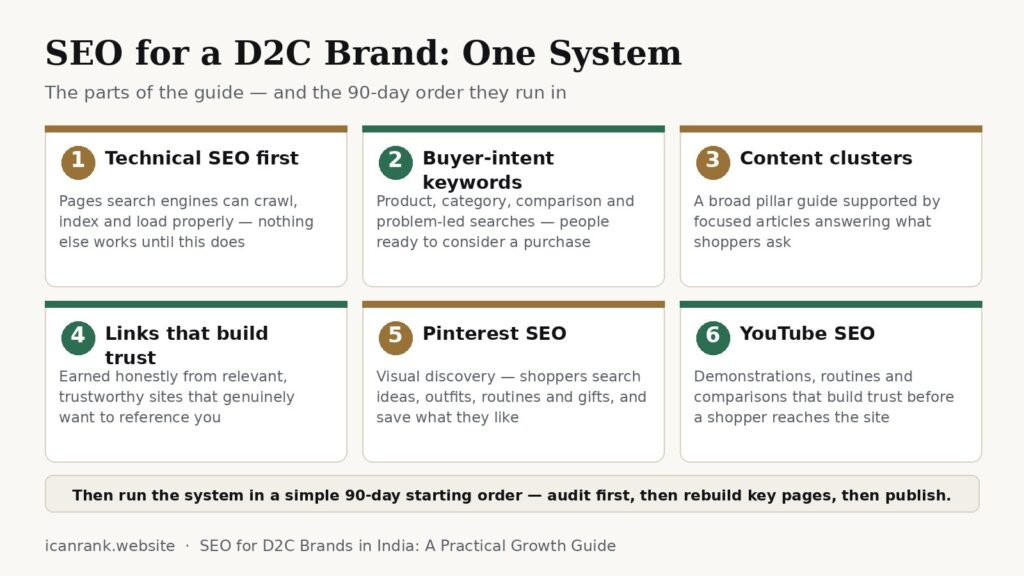
Technical SEO comes first because no amount of content can help pages that search engines cannot crawl, index or load properly. Check that important product and category pages are indexable, that there are no broken internal links, and that the site loads quickly on a phone as well as on a desktop. Use clean, descriptive URLs, a logical internal-link structure, and schema markup where it genuinely fits the page, such as product, organisation or article information. Fix duplicate titles, thin category pages and slow images before spending heavily on new content.
Once your overall strategy is in place, the pages that need the deepest work are your product pages — see our complete guide to product page SEO for D2C brands in India for the full fix sequence.
Target buyer-intent keywords, not just traffic
High traffic is only useful if it brings people who are ready to consider a purchase. Build keyword lists around intent: product searches, category searches, comparison searches, and problem-led searches such as how to choose, use or care for a product. Map each group to the right page type. Product and category pages should serve shoppers who already know what they want, while guides and comparisons should serve shoppers who are still deciding. Write for the shopper first, and use the keyword naturally in the title, headings and opening lines.
Build content clusters around what shoppers ask
A content cluster starts with a broad pillar guide and is supported by focused articles that answer related questions. For example, a skincare brand might build a pillar guide to choosing a routine, supported by articles on ingredients, skin concerns, sizing or usage, and seasonal care. A home or fashion brand can do the same with buying guides, styling ideas and care advice. Link the supporting articles back to the pillar page and to the most relevant product or category pages, so both readers and search engines can follow the path from learning to buying.
Earn links that build trust
Links from relevant, trustworthy sites act as a vote of confidence, but only when they are earned honestly. Publish resources that other sites genuinely want to reference, such as original guides, useful data, or clear explainers. Build relationships with creators, publishers and partners in the same niche, and make sure the brand is mentioned accurately. Avoid paid link schemes and irrelevant directory links, which can create risk without lasting value. A smaller number of relevant links from real sites is worth more than a large number of low-quality ones.
Use Pinterest SEO for visual discovery
Pinterest works as a visual search engine, not just a social feed. Shoppers search for ideas, outfits, routines, gifts and home inspiration, and save what they like for later. Give each pin a clear, search-friendly title and description, use relevant boards, and link pins to the most useful page on the site, such as a category page or a detailed guide, rather than always to the homepage. Fresh pins, consistent naming and images that show the product in use tend to perform better than repeated, generic graphics.
Use YouTube SEO for search and trust
YouTube helps D2C brands answer questions that text alone cannot. Short demonstrations, routine videos, comparisons and behind-the-scenes content can build trust before a shopper reaches the website. Title each video around the question it answers, write a clear description, use chapters for longer videos, and link back to the related product, category or guide. A video that genuinely helps a viewer is far more valuable than a video that only promotes a discount.
A simple 90-day starting order
Weeks one and two: run a technical audit, fix indexing and speed issues, and clean up titles, descriptions and internal links. Weeks three to six: rebuild the most important product and category pages around buyer intent, and publish the first pillar guide with two or three supporting articles. Weeks seven to twelve: publish consistently, build Pinterest and YouTube content around the same topics, and start earning relevant links through useful resources and partnerships. Measure organic sessions, rankings for buyer-intent terms, and enquiries or sales from organic search, rather than chasing vanity traffic alone.
If you would like help building this system for your own brand, explore the D2C SEO services offered by icanrank.website, or contact me in Kolkata, India to discuss your store, your goals and a practical next step.